
Take a look at another Bloggers experience at S21 and The Killing Fields.
Photography by Tom Benjamin
Take a look at another Bloggers experience at S21 and The Killing Fields.

Outside Phnom Penh ‘The Killing Fields’ can be found. This is an area where people were brought to be executed and buried in mass graves during the reign of the Khmer Rouge. In the center of the fields is a large white monument to the unknown people whose bodies were found in the graves. This monument is where they house 5,000 skulls in the various conditions in which they were found as a reminder to those who visit.

The grave sites were huge and compassion wasn’t considered when they nailed the signs in front of them reading ‘2000 bodies were found here’. It was a real shock. I stood there thinking about these people brutally killed and in most cases decapitated, all lying in this pit. And there wasn’t just one, there were many.

At The Killing Fields or Choeung Ek there are over 20 mass graves which contained around 9,000 human remains when they were exhumed. In Cambodia it is thought there are around 20,000 mass graves containing a majority of the 2 million people who are predicted to have died between 1975-1979.
One of the most disturbing facts was that only in 2004 had they started to bring those responsible to trial for the crimes they committed, though Pol Pot had already died in 1998. A year after I left Cambodia I read that one of the men who was recently brought to trial had died before sentencing. Since then, in 2014, two other men have been sentenced to life in prison for their involvement in the genocides.
It was truly a life changing visit and I feel that these places are important for us to visit as a reminded of the mistakes the human race has made. From my experiences in Cambodia and throughout Asia I did notice that they were unable to display the information respectfully and the shock factor was important.
In the center of The Killing Fields stands a huge monument to the thousands of people that were killed there and buried in the mass graves.
What’s inside may shock you.

The thousands of remains of those unnamed victims who were killed during the reign of the Khmer Rouge.

Layer and layer of skulls reached meters into the top of the monument.
 Learn more about Dark Tourism HERE.
I knew very little about Cambodia when I travelled there in 2011 and knew even less when it came to the atrocities that happened there in the 1970s. When deciding to travel through Cambodia I didn’t realise what I would learn and see there. Looking at my trip it was one of the most educational visits I have ever made.
What was most surprising was how recently the events had occurred. We often talk about the Holocaust and World War II, many people are educated in that subject. People know little about the Khmer Rouge and the genocide in Cambodia which had happened only 40 years ago.
In 1975 the Khmer Rouge under the reign of Pol Pot moved into Phnom Penh. They told the residents that they knew the Vietnamese were on their way, which was a lie, and they should evacuate the city, leaving them to seize power. Once they were in control they began imprisoning people they considered to be intellectual and a threat, along with anyone else they felt like.

The Khmer Rouge took over a school and then turned it into a prison where they tortured the people who were held there. You can now visit Tuol Sleng Genocide Museum as a tourist attraction where almost everything has been left as it was found by the Vietnamese in 1979. Barbed wire covers the windows and plaques of the survivors are displayed throughout the school grounds which has now become a museum.
Out of the estimated 17,000 people who where held in prison only 12 were found alive when the Vietnamese arrived in 1979. Out of those 12 only two are thought to be alive today. Prisoners were interrogated and executed in the prison, many were buried on site until there was no more room. Then prisoners were taken out of Phnom Penh to The Killing Fields were they were executed and buried in mass graves.

See the full post for Tuol Sleng Genocide Museum HERE.
This weekend marked 40 years since the Khmer Rouge rolled into Phnom Penh. During the 44 months of Pol Pot’s rule over Cambodia a quarter of the population would die during his attempt at building a perfect society. For most Europeans, especially if you didn’t live during this period, I think knowledge on these atrocities is limited as we were more taught about history that we are directly involved with.

Over the next few posts I will be looking at Cambodia from my own experiences and what the role of dark tourism is in today’s tourism industry. I feel like this post should come with a warning. I will take a realistic view of the situation and to some this might be hard to comprehend. When I gave a presentation to my university class on orphanage tourism I made one of my classmates cry.
If you are interested in the subject and can’t wait for the next post you should consider reading this article, Cambodia Forty Years After Genocide.
I would like to encourage you also to use the tag The Academic Traveller if you are writing a post that discusses the influence of tourism or takes a serious look at the motivations of our travel decisions. Together we can build a topic that gets to the core issues and impacts of tourism.


The Icefields Parkway is a truly spectacular drive through 140 miles of amazing Canadian landscape. A drive that takes you north through the mountainous region of Banff National Park and into Jasper. During the winter the snow swept highway takes you up into the mountains and down to the lakes with views that will take your breath away.

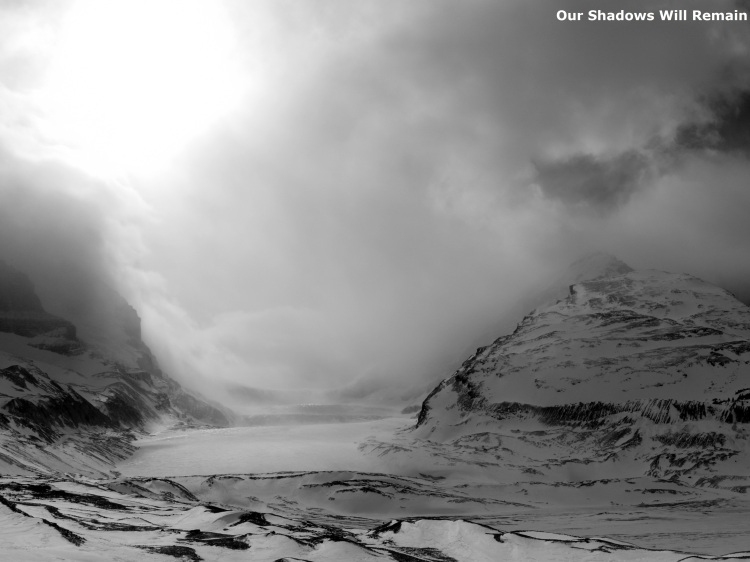
Travelling through in the winter we hardly saw a single person. There were huge car parks completely empty at every stop. This must be a very popular drive in the summer. When we stopped at the Athabasca Glacier we were completely alone as we took a short walk. There was one other car in the car park but no one in sight. In the windscreen was a note, ‘Be back Thursday’. That was four days away! As we looked up the majestic glacier and the clouds blew over we saw a person disappearing over the ridge.
Visiting the glacier put things in perspective. I had always heard about climate change and how the planet was changing but, until this point, I had never really seen any physical proof. At the car park there was a sign that indicated where the glacier was in 1890. Then we walked past 1935 and 1990. It was jaw dropping how far the glacier had retreated. The rate at which the glacier moved forward was not enough to keep up with the speed at which it melted.
It would have been a completely different trip in the summer, the roads covered in cars, people all over the place. I enjoyed the drive in the winter, it created a beautiful and harsh landscape. The complete opposite of the summer. There was one thing, everything was covered in snow. At first it was beautiful but then I grew slightly tired of seeing frozen lakes covered in waist deep snow. it would have been nice to enjoy the beauty of summer and but still I wouldn’t have traded it in.
To see what Banff National Park looks like in the summer why not take a look at the blog Rockies Outdoors.

 Our Shadows Will Remain