Being back in the U.K I had one day to make a trip to a nearby city. As I had been to the neighboring city of Bristol a number of times I thought I would revisit Bath since my last trip they was over ten years ago and I remembered very little of the historical city.
The city of Bath is well know for its Roman Baths and its yellow stone buildings, these can be found almost as soon as you step out of the train station. The city is small and much of it can be enjoyed by walking and that’s what I did. If I had more time I would of liked to walk the six mile walking route that allows views over the city, maybe next time.
My tip for Bath would be once you have seen the Abbey and Roman Baths follow the River Avon until you find The Circus, three rows of terrace houses set out in a circle.
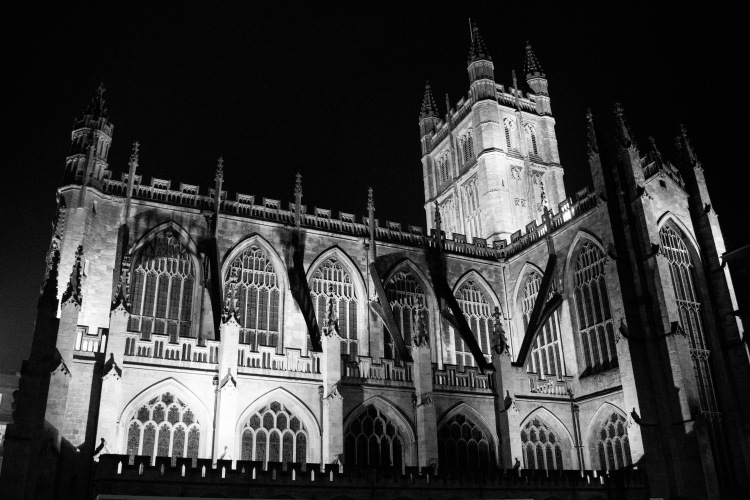
Even though this is an excellent door situated in the front of the Abbey, visitors enter through a side door to the left, and of course, exit through the gift shop.
Now that I have finally been able to get things together after the hectic holiday period, I can start sharing with you my photographs from my trip to England and especially those from the beautifully city of Bath.
Out of the many photographs I took this one inside the Bath cathedral has to be one of my favourites. The low angle shows just how high those ceilings are and what an impressive architectural achievement it is. I would have liked to have the aisle empty but it was a very busy day and was lucky to get it with only a few people at the far end.
What are your thoughts? Any great places in Bath you can suggest?
I am thinking of joining Flickr as I have heard it is a great place for photographers to share their work. I have recently started to post on Instagram and already find that time consuming.
I would like to hear other people’s opinions, what are the benefits to Flickr? Apart from WordPress where else do you post your photographs?
Send me your links and I’ll be sure to follow along.
Over this year I will attempt to post everyday. It will mostly be the photographs I take but a few travel stories and experiences as they come. I will also be taking part in the Dogwood challenge again and I would recommend it to anyone who is looking to improve their photography and meet like minded people.
I was lucky enough to accompany Global Degree and Day With A Local on a tour of the Porkkala region in Southern Finland as part of a YouTube series that will be released next year.
After catching an early train from Helsinki we arrived in Kirkkonummi where we were driven to Sjundby Manor. When we pulled up and exited the van an elderly man in uniform approached us speaking only in Russian. With little knowledge of exactly where we were the Global Degree team looked at me and our guide for help but none came. For all they knew we could have actually been in Russia, if this had between 1944- 1956 we would have been.
Sjundby Castle
After the conclusion of the Second World War the area of Porkkala was leased to Russia for fifty years but fortunately it was returned after only eleven. The area was of a tactical advantage to Russia as it was the narrowest and shallowest stretch of water between Finland and Estonia, allowing them to closely monitor and secure the passage to St Petersburg.
Once the agreement had been made the whole area had to be evacuated in just nine days, over 7000 residents, 8000 domestic animals, as well as any crops and vegetables. At first not even trains could pass through the newly acquired area, but after 1947 they were finally permitted but the shutters had to be pulled down to cover the windows.
After a brief view of the castle we were directed to a slightly more interesting building in my opinion. Between the road and the river there was a building covered in Russian text preserved for more than fifty years. Our Russian officer, now speaking in English, explained to us about the area and its history before posing for some Soviet era photographs.
The landscape of Porkkala had changed, what had once been an agricultural landscape was transformed by the Russians into a heavily fortified military facility. It is thought that 20,000 military personnel and about 10,000 civilians occupied the area during those eleven years.
It was now that we travelled a little further and saw what was remaining of the fortifications that had been built. An entrance to a bunker hidden from the road. It continued meters underground but the roof had collapsed making it now inaccessible. There is thought to be many more in the area, some have been found but others have not so it is difficult to estimate how many exactly were built.
Here it wasn’t only the bunker that was of interest but the area surrounding it that had once been a barracks with a fully operating crematorium, our guide added, “Still no one knows what they were burning there.”
As we drove through the region there was little evidence and even less that you would have noticed without being pointed in the right direction. Many of the houses had been left to decay after the residence moved out in 1944, little of who returned, and it was only in recent years that development in the area had really begun.
It was an incredibly interesting area with a history that I had never discovered until now even though it is only 19km from Helsinki. One of the most memorable stories of the day was of two seventeen year old boys that accidentally sailed into the area and were picked up by a Russian patrol and imprisoned. After a few days they thought they were being released and taken back to Helsinki by train but they ended up in a death camp in Siberia where they were put to work for a number of years.
Next stop, Fiskars Village. Post coming soon!
Further Reading:
I highly recommend the article Seven Years Sailing about the two boys who ended up in Siberia after an innocent sailing trip.
Over the last year I have been concentrating much more on my photography and would like to continue you doing so over the year, and possibly, the years to come. So I have decided with the help of this challenge to post a photograph a day during next year.
What is your challenge for next year?
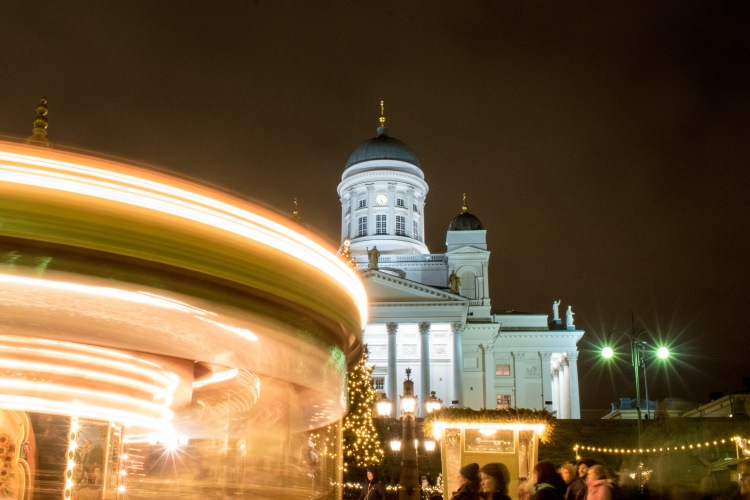
Lately I have been photographing the Russian Cathedral in Helsinki frequently and you can see another angle HERE.
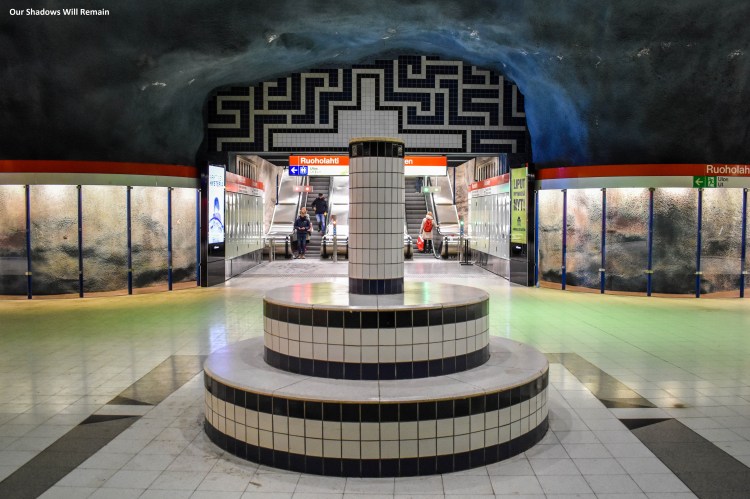
Just like the University of Helsinki metro station, Ruoholahti metro station is one large piece of art. The station is decorated with white and blue ceramic tiles that culminates with a stepped plinth on the platform level that is characteristic of a piazza. The station opened in 1993 with the installation by artist Juhana Blomstedt.
Further reading:
I have explored and photographed the Helsinki Metro plenty of times over the years I have lived in the city.
You can find almost 500 outdoor sculptures, pieces of environmental art and historical monuments in Helsinki and they are accessible to everyone. See more and search through the database at HAMhelsinki.fi.
Last week this view in Helsinki was full of colour, ruska was here and the city looked beautiful.
Yesterday saw the first snow and that means only one thing, winter is on the way. We don’t know for how long it will last but there is one certainty, more snow will come and the lake will eventually freeze.
Are you looking forward to those cold winter months? What are your tips for surviving winter in a city?







 Our Shadows Will Remain