Nordkapp was once thought to be the northern most point of the Norwegian island Magerøya and has become the ending point for many peoples journey. But in actual fact Knivskjellodden point is further north and has become a popular walk for people trying to avoid the crowds and high entrance fees of Nordkapp.
7km south from Nordkapp is a small car park, from here it is a 9km walk one way to Knivskjellodden point at 71° 11′ 8″ North. With the parking spot being up hill it is a pleasant and easy walk down to the coast and along the point to where the monument stands. The route is one way which makes the return journey a little less exciting especially after you have reached your goal, to make matters worse it is a slow incline back to the car park that never seems to arrive.
There are many reasons to choose this walk over visiting Nordkapp but the reason I did it was because it was different and far from the usual. It does take more time and effort but once you reach the modest monument you are rewarded with beautiful views of the Norwegian coastline, the Barents Sea and the steep cliffs of Nordkapp, you may even be alone.
Enjoy my gallery of photographs taken from Knivskjellodden point and the monument, Nordkapp can be seen in the background shrouded in cloud.
Beneath our feet is millions of years of history written in the soil and rock formations. In different places across the planet there are signs of how the landscape has slowly been shaped into what we see and admire today. True natural wonders.
The last few weeks I have been travelling and had little time to post my experiences, I look forward to sharing them with you very soon. For now here is a sight that I haven’t seen for the last few months. Lapland has been without a sunset for the last two months but while travelling to southern Finland I was able to see one again and it was beautiful.
Many cities have a landmark, place or object that symbolizes the city and represents it’s imagine to the world, London has the Houses of Parliament and Big Ben, New York’s would probably be the Statue of Liberty and the freedom it represents to the American people, and Paris the Eiffel Tower.
This week I am back in Helsinki and there is no better time to share some photographs of, what I think, is the symbol of the city, Helsinki Cathedral.
Helsinki Cathedral, or as it is more commonly known the White Church was designed by C.L Engel and built in 1852 when it became a prominent feature in Senate Square. What is most impressive about cathedral is that it stands tall above all other buildings in the central area and it can be seen from all over the city.
Taken during my visit to Norway a few months ago this photograph is of the explore Helmer Hanssen’s statue in Tromso. Helmer Hanssen was one of the first five people to reach the south pole during the 1911 expedition. The dogs and the figure look life size in front of the Norwegian landscape but in actual fact they are relatively small, the sitting sled-dog in the foreground of the photograph is around 30cm tall.
This is part of a black and white photography challenge on Large Subjects and Statues.
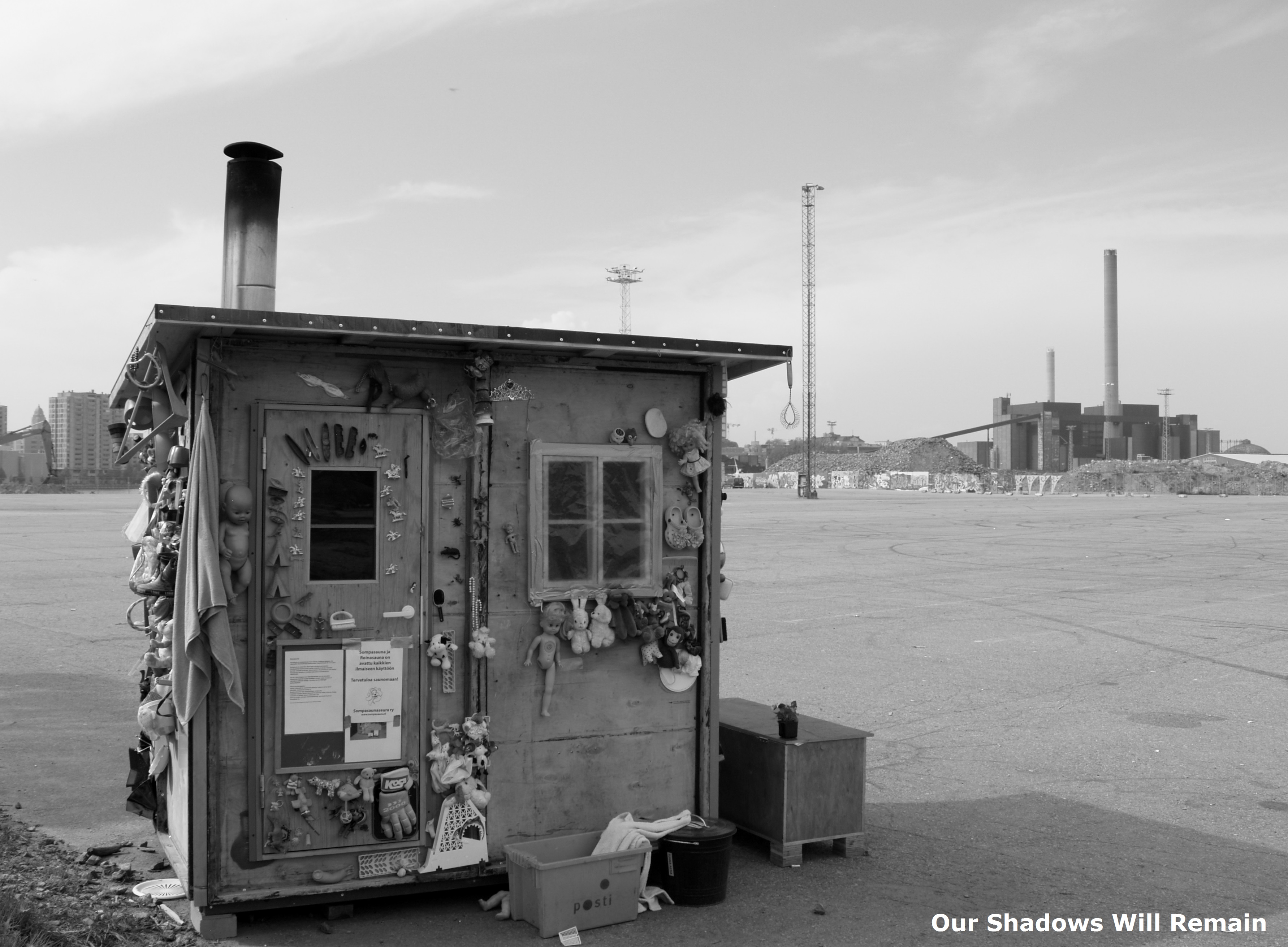
In a remote part of Helsinki’s center there is a unique spot with a great view and a hive of cultural activity. Behind the power station in a large disused car park there is this small shed overlooking the city. Inside this shed and behind the bizarrely decorated door is a community organised public sauna.
In recent years it has become difficult to distinguish ecotourism from nature tourism, sustainable tourism, wildlife tourism, adventure tourism and how it relates to other forms of tourism. In nature tourism the attraction and the enjoyment comes from nature and the natural environment. Ecotourism is a sub-segment of nature based tourism along with adventure tourism and wildlife tourism. What distinguishes ecotourism is the inclusion of an educational aspect or sustainable management.
Ecotourism is a more strict form of nature tourism where education and sustainability are used as components to create an ethical experience for the consumer. Ecotourism can be described as a more sustainable form of nature based tourism that primarily focuses on experiencing and learning about nature. It is managed to be low impact, non-consumptive and locally orientated. It typically takes place in natural areas and should contribute to the conservation and preservation of those areas.
Lapland, Finland
It can be predicted that ecotourism will see continued strong growth as it is seen as self-reinforcing, as people experience something new, exciting or scary they might create an interest to explore more powerful experiences. Ecotourism is generally small scale which helps to reduce the negative environmental and cultural impacts, this also guarantees unique experiences. As activities have little impact on the environment and are largely unproblematic from a cultural perspective a large share of nature tourism fulfills the criteria for ecotourism. Now, we can notice a growing trend in ecotourism as it is increasingly offered in a wide variety of locations and creates new products strategically marketed to create new markets.
Generally there is a greater awareness of the environment and its issues that include pollution, deforestation and global warming. Governments and environmental organisations are taking these issues seriously at both a national and international level. People’s interest in these issues has changed accordingly and they want to engage in nature or ecotourism and partake in activities that have a benefit to the local environment.
Due to this increased awareness it has become easier to manage protected areas as people understand the need for this action. To promote eco-friendly tourism it is important that there is a development in partnerships between tourism, environmental and community interests. These partnerships need to have a shared understanding in the processes and the benefits in producing eco-friendly tourism.
When you travel is preserving the environment and local surroundings important to you? What experiences have you had as an ecotourist?
Everyman’s Right is often more fairly called Freedom to Roam or Right to Roam, and is in reference to the public’s right to enjoy and access natural surroundings for recreation and exercise. This right exists in many different forms and in many countries, within Nordic countries the right exists in its most purest form.
Finland adopts the ‘Everyman’s right’ when it comes to the accessibility of natural areas such as national parks and nature reserves. Everyone has the unique opportunity to move freely and is granted safe access to the wild with very little restrictions.
Metsahällitus is a state owned enterprise that controls millions of hectares of state owned land and water where they maintain nature, huts and lean-tos, and hiking trails that are available free to all hikers. Mushroom and berry picking is a pastime that stretches back many years in Finland and anyone is allowed to forage in the forests. Camping, hunting and fishing are allowed too but with some restrictions that have been put in place to ensure they are controlled.
Does your country adopt the ‘Everyman’s Right’? In your opinion, is the right good for the environment, wildlife and our natural surroundings?
Lapland in Summer
Feel free to use the tag The Academic Traveller if you are writing a post that discusses aspects of tourism and together we can build a topic that gets to the core issues of tourism and the environment.



 Our Shadows Will Remain